 Back to blog


One of my clients grew revenue 82% while I cut the ad budget in half, in about six months. There was no clever bidding trick behind it. Just three things done in the right order, and a refusal to skip ahead.
A number like that sounds too good to be true, and on a healthy account it would be. This one wasn’t healthy. It was double-counting conversions, carved into too many campaigns, and spending real money on waste. Most of that 82% was the account finally running clean, not a growth trick. The more broken the starting point, the bigger the swing looks once you fix it, and a lot of accounts are starting from further back than their owners think.
The problem in most accounts that won’t grow profitably isn’t the bids and isn’t the budget. At any given moment, your account is in one of three phases, foundation, efficiency, or scaling, whether you named it or not. And almost every stuck account is making the same move: trying to grow from the wrong place.
So the whole job is short to say and hard to do. Find your phase, finish it, and only scale once you’ve earned the right.
The one mechanism underneath all of it
Before the phases, the thing they all sit on: Google’s bidding is only as smart as the data you feed it, and only as confident as the amount of that data.
Feed it dirty conversions and a thin feed, and it guesses. Give it one campaign with real volume, and it learns. Spread that same volume across ten campaigns, and every one of them goes back to guessing. Almost every structural mistake I see is some version of starving the bidding of the data it needs, then blaming the algorithm for the result.
That’s why the order matters more than any single setting. Each phase exists to give Google a specific kind of confidence before you ask it to do more.
How to read the map: 3 phases, 2 gates
I put the whole framework on one page. It looks almost too simple, which is exactly why people scroll past the one thing that would have saved their account.
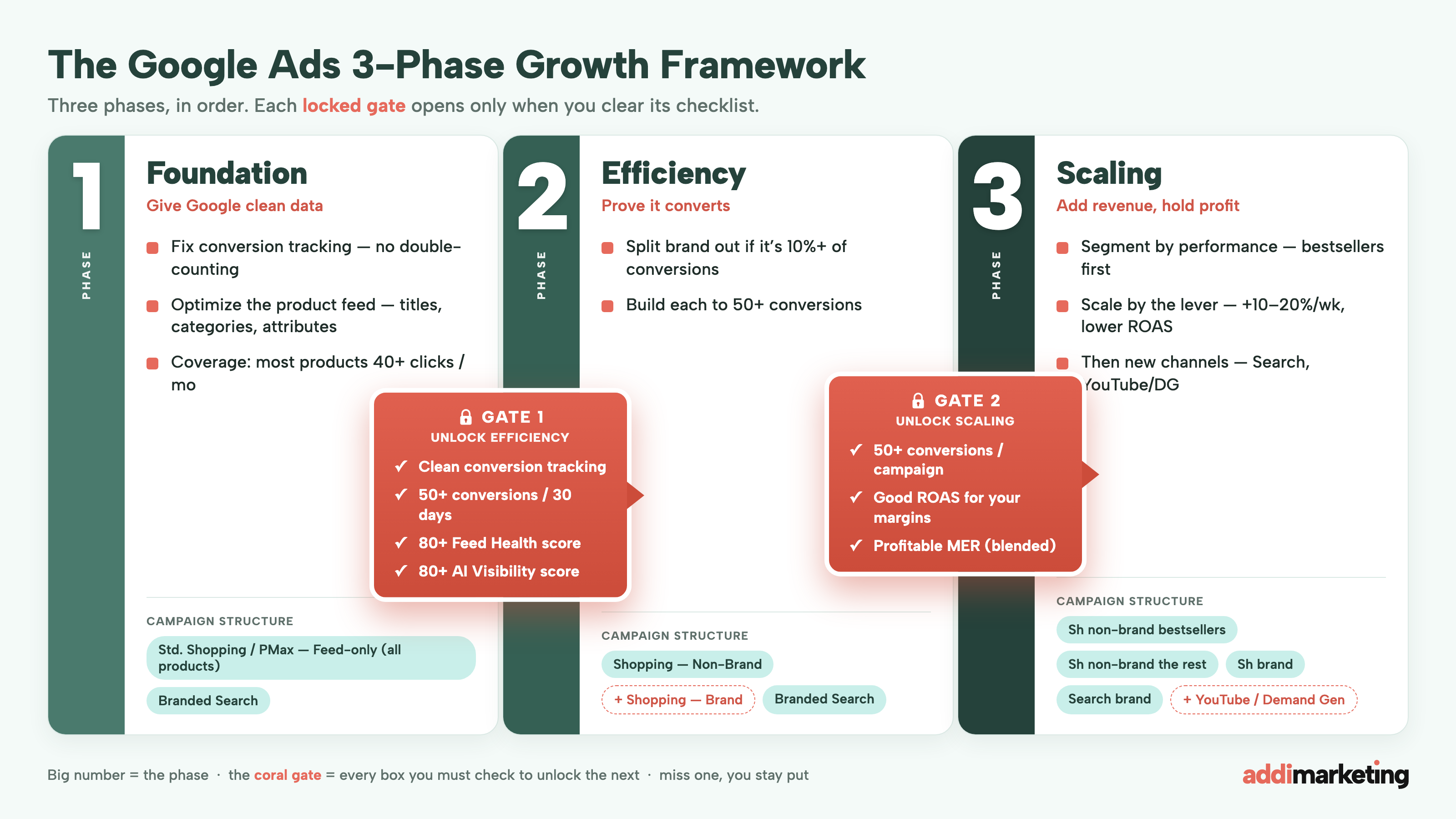
Read it left to right. Foundation, efficiency, scaling. The order is the whole game, and you move through it in sequence. You don’t jump to scaling because the dashboard looks good this week.
Each card tells you the same three things: the phase’s goal, the two or three moves that actually matter, and what your campaign structure looks like while you’re in it. Watch that structure as you move right. It grows on purpose. You start with two campaigns, then split Shopping into brand and non-brand, then segment further. You earn each new piece, you don’t open with it.
The piece that decides everything is the gates between the phases. Each gate is a checkpoint with specific numbers you have to hit before you’re allowed into the next phase. Clear it and you move on. Miss it and you stay where you are. That single rule fixes most of the accounts I audit.
Now let’s walk the phases.
Phase 1: Foundation, give Google clean data
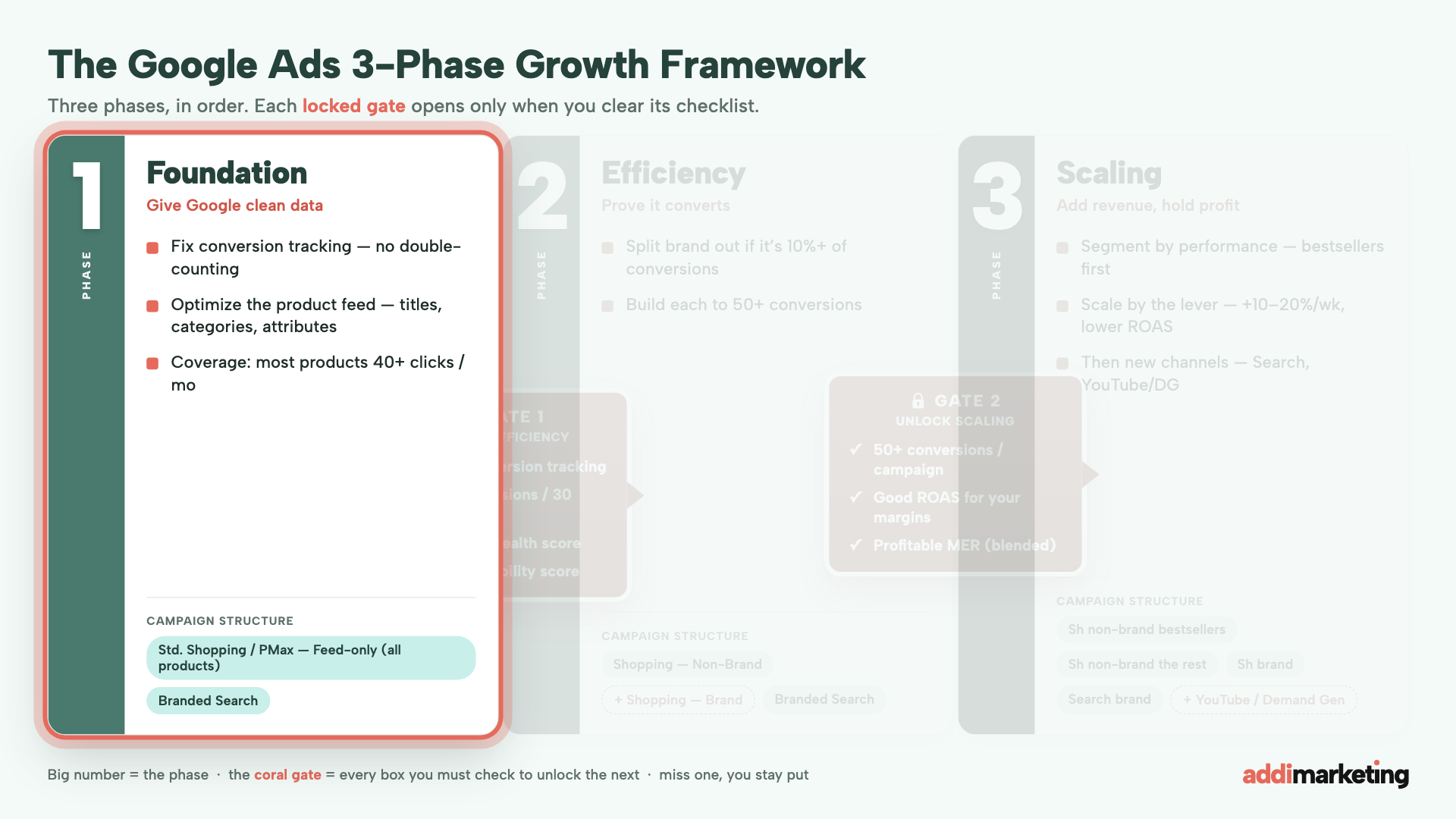
Foundation has three goals, and you don’t leave until you’ve done all three.
Fix your conversion tracking so nothing’s counted twice. I constantly audit accounts where the same sale fires two or three times and the dashboard shows a 6x that doesn’t exist. Bad data in, bad decisions out. Fix this first, because every number after it depends on it.
Optimize your product feed. This is the most important setup job in the account. Your feed is the data Google reads to understand what you sell: titles, categories, images, prices, and the other attributes. Shopping is the foundation of an ecommerce account, and your feed is the foundation of Shopping. Get it wrong and your bidding never gets traction. The catch is not to overcook it. Natural, keyword-rich titles, accurate categories, real prices. Complete and clean beats clever.
The feed matters more every month, not less. AI shopping assistants now read it to decide which products to surface and recommend, and Google’s newer AI-powered campaigns use it to build the ads and choose what to show first. How visible your products are to all of that is what an AI visibility score measures, so clean for Google today is visible to AI tomorrow.
Get traffic to most of your products. This is where structure comes in, and where people overcomplicate the most. Keep it to two campaigns. One carries your whole catalog, a Standard Shopping campaign or a feed-only Performance Max, no Display or YouTube assets yet, just clean Shopping data from every product. The other is a branded search campaign to protect your name. That’s it, two. The goal is coverage: you want most of your products getting clicks, at least 20 to 40 a month, because that’s how the campaign learns which ones can sell. You can’t pick winners you never gave a chance, so resist the urge to carve things up early.
Gate 1. Tracking clean, feed optimized to 80 or higher on both feed health and AI visibility, and at least 50 conversions in your campaign over the last 30 days. Why 50? Below that, Google’s bidding is basically guessing. Hit all three and you’ve cleared the gate, not before.
Phase 2: Efficiency, prove it converts
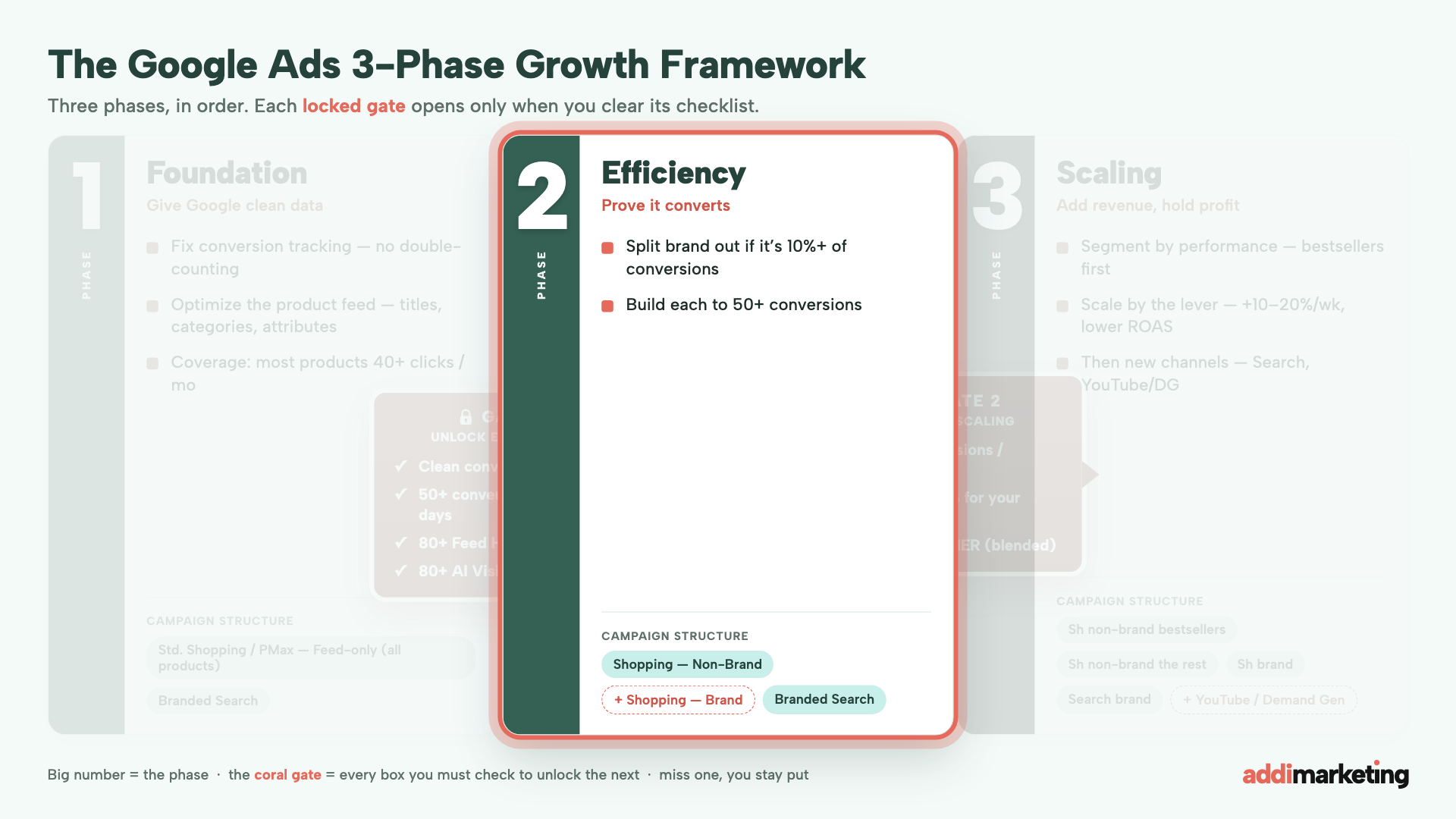
You have volume now, so this phase has one goal: prove the account converts efficiently, not just that it spends. The move that gets you there is separation, but only where the data earns it.
Check how many of your Shopping conversions come from people searching your brand name. More than about 10%, pull brand into its own campaign and leave the rest as non-branded. Less than that, leave it as one, because the split wouldn’t earn its keep yet. Once you split it out, you finally see which part of the account buys new demand and which just harvests people who already knew you.
Then build each campaign you split to at least 50 conversions of its own. Not 50 combined, 50 in each. If the split was worth it, your structure grows to three: non-branded Shopping, your real revenue engine; branded Shopping, the cheap, high-ROAS demand you already own; and the branded search campaign from phase one.
Gate 2 is stricter. At least 50 conversions a month in every Shopping and PMax campaign, each one and not the total. A good ROAS for your business, and more importantly a profitable MER, your marketing efficiency ratio, total store revenue divided by total ad spend. This is the gate everyone wants to skip, and skipping it is exactly why their scaling falls apart later. If you want the longer argument for managing to MER instead of platform ROAS, I wrote it up in why blended ROAS is the metric to obsess over.
Phase 3: Scaling, add revenue and hold profit
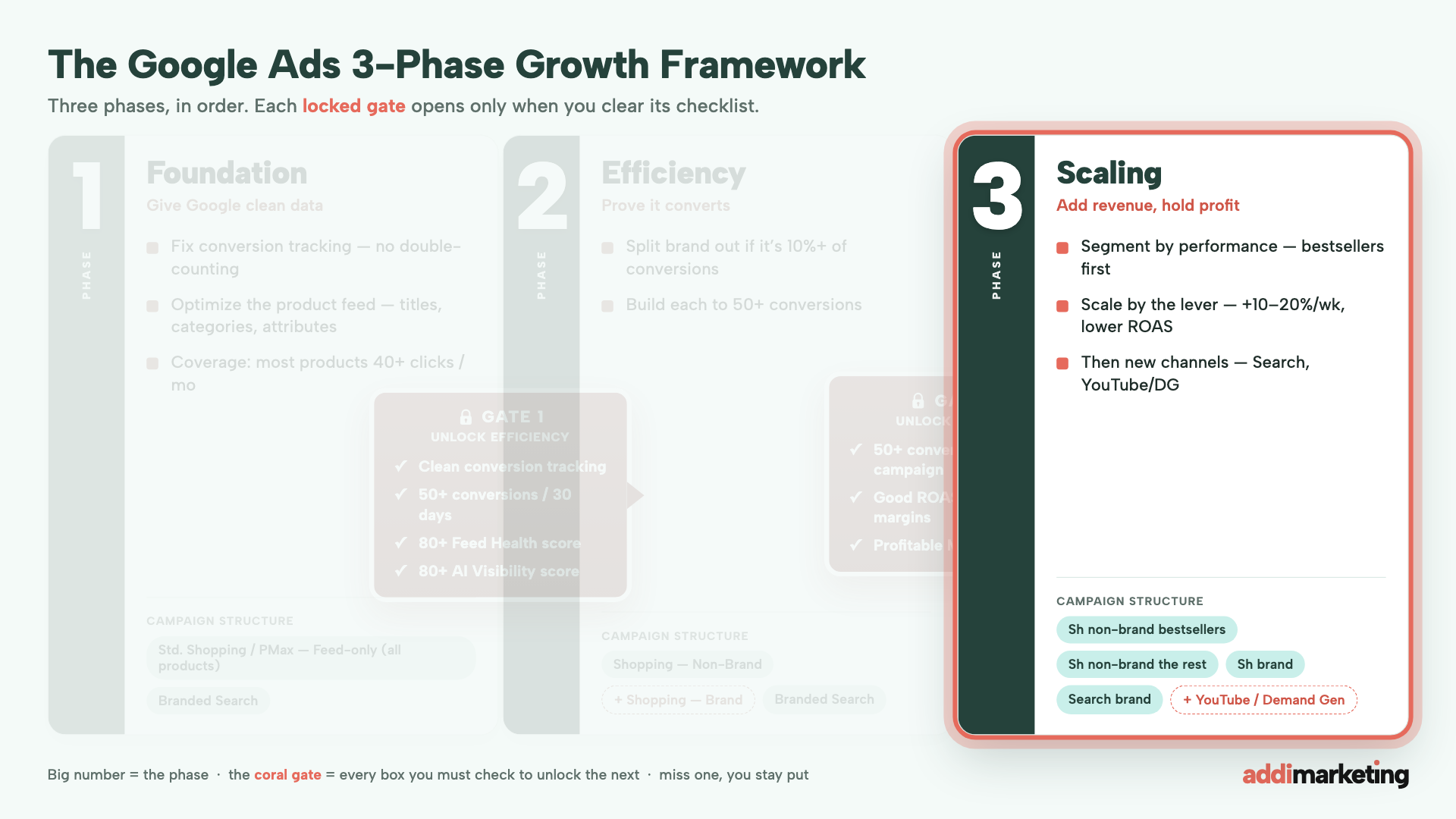
This is the phase everyone wants to start in, and now you’ve earned it. It has three goals, in order.
Segment your Shopping so the budget follows your winners. Up to now your non-branded Shopping has been one campaign, with bestsellers and dead weight sharing a budget. Break it up starting with your proven winners. Pull budget into the products that actually sell and leave the long tail on a smaller budget. Each new campaign still has to clear the 50-conversions bar, so only split when the volume supports it.
Scale revenue one lever at a time, never all at once. Raise the budget on your proven campaigns 10 to 20% a week, or lower your ROAS target in small steps so Google bids a little harder for volume. One lever, watch what happens, then the next. Move two at once and you can’t tell which one did what.
Add new channels, but only now that the rest is working. Non-branded search built from the search terms you already watched convert, then channels like YouTube or Demand Gen. New channels are a phase three move, never a phase one move, no matter how good the pitch sounds.
And watch the right scoreboard: revenue growth at a healthy ROAS, more new customers, and a lower cost to win each one. Scaling is only real when growth comes from new people, not from rebuying the customers you already had. There’s no finish line here. If growth is the goal, you live in this phase, running the budget-and-target loop and guarding the foundation underneath it.
The number-one mistake: splitting too early
Someone launches five neat campaigns, and now no single campaign gets enough conversions for Google’s bidding to learn. It looks organized and performs terribly. The map makes it obvious: the account is already carved into five campaigns even though its numbers never cleared gate one.
The same trap runs in the other direction. Someone runs the phase three budget loop on a phase one foundation. Great-looking ROAS, thin data underneath, and the second they scale, it collapses.
So find yourself on the map. Don’t ask which phase you wish you were in, ask which gate you’re stuck at. Feed under 80 and still grinding toward 50 conversions? You’re in foundation, so work the feed and coverage, not the budget. Past 50 and splitting brand from non-brand? Efficiency. Fifty in every campaign at a profitable MER and a good ROAS? You’re clear to scale: winners first, then the budget lever, then new channels.
Build the floor, then raise the ceiling
None of this is exotic, and the edge is entirely in the order. Foundation before efficiency, efficiency before scaling, and a gate you actually have to clear between each one. If you want to go deeper on the campaigns that live inside these phases, I broke down the eight building blocks of an account built to scale in a companion piece.
I’ve put this whole framework on a single clean page, all three phases and every gate, so you can grab the one-page 3-phase growth framework, print it, and stick it next to your screen. And if you want a hand figuring out which phase your account is in, write to me.

Andrey Kisselev
With over 10 years managing 50+ accounts, he helps brands and DTC stores grow revenue efficiently through hands-on Google Ads management and practical advice.